From Guild Workshop to Shared Studio
From guild workshop to shared studio: shape a four-week learning routine that pairs guided teaching with peer exchange and independent making.
The common mistake in a shared studio is to copy the guild workshop’s hierarchy without noticing: one experienced maker demonstrates, everyone else watches, and the room grows quiet. That can leave newcomers unsure how to ask for help and experienced makers repeating the same lesson. A better routine borrows the guild’s deliberate teaching, then makes room for peers to learn from one another and for each person to work independently.
The shift from guild workshop to shared studio is not simply a move from old-fashioned instruction to open access. It is a change in how a group distributes knowledge, responsibility and attention. A four-week routine can help a small creative group try both models without pretending that every member has the same experience or goals.
What changes between a guild workshop and a shared studio?
In a guild workshop, an apprentice commonly learned through close observation, repeated practice and correction from a skilled maker. The teacher’s authority was clear, and learning was tied to the standards and customs of a particular craft community. That arrangement can make difficult techniques easier to pass on, but it can also keep decisions concentrated in a few hands.
A shared studio puts people in a common working space without requiring one fixed teacher. Members may bring different skills, projects and reasons for being there. Learning can happen through a demonstration, a question across the table, a peer’s feedback or simply seeing how someone solves a practical problem.
Neither model is automatically fair or useful. A shared room still needs ways to welcome beginners, pass on specialist knowledge and make decisions about tools and space. The aim is not to erase expertise, but to make it visible and available without turning one person into the permanent source of every answer.
How can a four-week routine make the change workable?
Set a recurring session that the group can keep, such as one evening each week. Agree on the basic room arrangements before starting: who opens the space, how tools are returned, what work may be brought in, and how someone can ask for help without interrupting focused work. Keep the routine light enough to adapt, but specific enough that people know what happens next.
- Week one: map what the group knows. Each person brings a current piece of work or a material they want to understand. Take turns naming one skill they can share and one question they have; write these on a sheet everyone can see.
- Week two: teach one small technique. Choose a technique from the group’s list, and ask the person most comfortable with it to demonstrate. Leave time for everyone to try it, ask questions and record the part they want to practise later.
- Week three: organise peer exchange. Pair people around a question or material rather than matching only by experience. One person explains what they are trying; the other asks clarifying questions and offers an observation, then they swap roles.
- Week four: review and choose what continues. Put the week-one questions beside what participants have learnt. Decide together which demonstration, exchange or room arrangement should become a regular feature, and which needs changing.
For every meeting, keep a short opening and closing. At the start, name the session’s purpose and any shared-space constraints; at the end, ask what someone can now do, what remains unclear and what they would like to bring next time. This turns the routine into a learning practice, not merely a booking in a room.
Who should lead, and when should others take over?
Leadership can move with the subject. A person who knows how to prepare a printing screen may lead that demonstration, while someone else can guide a conversation about colour, composition or presenting work. Make the role temporary and defined: the session lead introduces the subject, explains the limits of their knowledge and invites questions, but does not have to solve every problem.
Some knowledge needs careful instruction. If a process depends on a machine, a specialist material or a particular studio rule, ask the person responsible for that equipment or practice to explain its proper use. For safety-critical or regulated work, follow the relevant manufacturer instructions and local rules, and consult a qualified professional where needed.
Other questions benefit from several perspectives. A maker deciding how to arrange a small series of drawings may need responses from peers more than a formal lesson. In that case, the session lead can keep feedback focused: ask what the maker wants help with, invite observations before suggestions, and let the maker choose what to use.
Share leadership by inviting people to propose a session, not by assigning the same confident members every time. A person who does not want to teach a formal demonstration might still bring a useful question, prepare materials or help a newcomer find a place to start.
How should the studio share its tools and attention?
Shared resources create a different kind of lesson from a guild’s master-apprentice relationship. They ask people to notice how their individual work affects everyone else. Set out a simple, visible way to reserve scarce tools or surfaces, and agree how members will leave them ready for the next person. Make room for low-cost ways to take part when a project needs materials the studio cannot provide.
Attention also needs sharing. When one member receives a long stretch of feedback, others may have no clear opening to ask a question. Try a round in which each person states a current need in one sentence, then let the group decide which questions suit a demonstration, a pair exchange or a separate conversation.
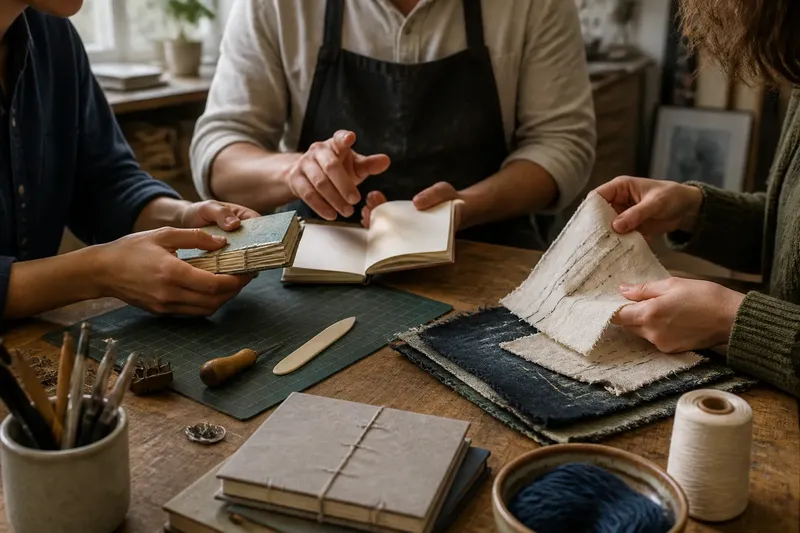
Imagine a group that meets around a community table, where one member wants to learn basic bookbinding and another is preparing a textile piece. The bookbinder could demonstrate a simple fold and invite each person to make a test booklet; the textile maker could then ask the group to look at how a seam changes the fabric’s drape. The expected observable result is that members leave with a small practice object and a clearer question for their own work, rather than expecting either project to be completed during the session.
What should the group do when a session feels uneven?
Notice the specific problem before redesigning the whole routine. If a demonstration has become a lecture, pause for participants to try the technique and name what is confusing. If beginners are staying silent, offer a question they can answer by pointing to a material or showing a first attempt, rather than asking them to assess their own ability.
If one person is continually asked to advise everyone, make the knowledge gap visible. Add the question to a future session, invite another person with relevant experience to contribute, or agree that the group needs an outside teacher. A shared studio should not disguise unpaid, unrecognised labour as effortless generosity.
When members want different things from the room, separate the needs rather than forcing one activity to serve all of them. A focused skill session can sit alongside an open making session on another occasion. Tell members what each gathering is for so they can choose where their time and attention fit.
Which questions help a shared studio routine take root?
Does a shared studio need a teacher?
Not for every session, but it needs access to teaching when a technique or decision calls for it. A rotating session lead, invited specialist or peer demonstration can provide direction without making one member responsible for everyone’s progress.
How can beginners take part without slowing others down?
Give newcomers a clear way to ask for an introduction, and pair that invitation with a manageable practice task. Experienced members can continue their own work while making a bounded offer, such as showing how a tool is set up or explaining a material choice.
What if no one in the group knows the answer?
Name the gap plainly and decide how to pursue it: consult a reliable manual, ask a suitable practitioner or arrange instruction. Treating uncertainty honestly is part of learning together, not a failure of the studio model.
How can members tell whether the routine is useful?
At the end of each week, ask what people attempted, what they can explain more clearly and what they want to practise next. If members are making work but cannot get the kind of help they need, adjust the format rather than assuming that attendance alone means the routine is working.
What should continue after the first month?
Keep the parts that help people learn and make, and let the rest change. The group might retain a short demonstration at the start of each month, peer exchanges when a project calls for them, and open sessions for independent work. Put the next meeting’s format where members can see it, along with a way to propose a subject.
The shift from guild workshop to shared studio works best when it is treated as a practical redistribution of learning: skilled members still teach, but knowledge can travel in more than one direction. For a useful next session, ask each person to bring one technique they can explain and one question they would welcome help with.