A First Group Project Without the Awkward Handoff
Plan a first group project with clear roles, a shared definition of done and simple handoff notes, so collaborators can keep work moving without guesswork.
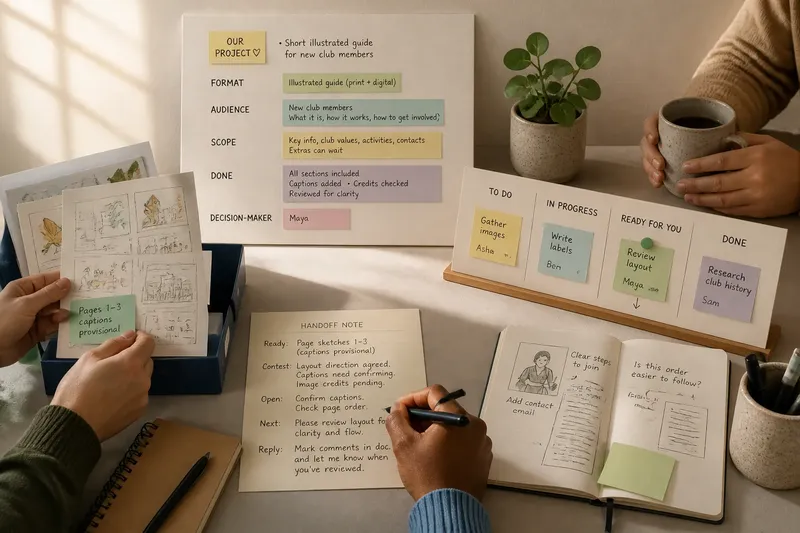
The most common first-project mistake is assuming everyone means the same thing by “finished”. One person may deliver a polished draft; another may expect a rough outline for review. A first group project works more smoothly when you agree on the result, name who owns each part and decide what information travels with the work.
This is not about making a small creative project feel like office paperwork. A few clear agreements let people contribute in their own ways without leaving the next person to guess what to do. The aim is a shared route from one person’s contribution to the next.
What should the group agree before starting?
Start with a short description of the finished piece. Say what it is, who it is for and what it should let someone see, hear or understand. “A short illustrated guide for new club members” gives a group more to work with than “something about the club”.
Then define what counts as done for this particular project. Make the definition observable rather than relying on words such as “good” or “ready”. For example, a finished draft might include all planned sections, captions beside the relevant images and unresolved questions marked for review.
Keep the definition modest enough to guide decisions. It need not settle every creative choice in advance. It should help the group distinguish a deliverable that is ready to pass along from one that still needs its owner’s attention.
- Format: What will the group make: a zine, audio piece, display, performance or another form?
- Audience: Who is meant to encounter it, and what should they be able to take from it?
- Scope: Which parts belong in this project, and which tempting additions can wait?
- Done: What visible conditions need to be met before the work moves on?
- Decision-maker: Who resolves a choice if the group cannot agree quickly?
Write these answers where every participant can find them. A shared document, paper planning sheet or pinned note can all work; choose a format the group will actually check.
How do you assign roles without boxing people in?
Give each task one clear owner, even when several people help with it. The owner keeps track of the task and prepares it for handoff; they do not have to make every contribution alone. This avoids the vague ownership of “we’ll all do the artwork” while still leaving room for collaboration.
For a first project, separate the work into pieces that can be seen and passed on. A small exhibition might need someone to gather images, someone to write labels, someone to plan the display and someone to coordinate the final review. One person can hold more than one role if the workload suits them.
Ask what each person wants to try, what they already feel able to do and where they would welcome a partner. Avoid assigning a role solely because someone is quiet, confident or already familiar with a tool. Roles should reflect interest and available capacity, not a fixed judgement about talent.
Make a simple role note with three details: the owner, the deliverable and the person or people who need it next. If a task has no next recipient, it may not need to be a separate handoff at all.
What belongs in a useful handoff?
A handoff is a small package of work plus context. The next person needs to know what they have received, what has already been decided and what action is expected. Without that context, even a strong contribution can stall while its recipient tries to reconstruct the conversation.
Agree on one place for the current files and notes. A shared folder can hold drafts; a shared board can show task status; a group message can flag that something is ready. Avoid scattering the authoritative version across personal inboxes and chat attachments. Name files plainly, such as “labels-draft” and “labels-review”, and mark which one is current.
Use a handoff note that is brief enough to fill in each time:
- Ready: What are you passing on?
- Context: What choices or constraints should the next person know?
- Open: Which details still need a decision or check?
- Next: What action should the recipient take?
- Reply: How should they signal that they have received it or need clarification?
Say, “The label draft is ready for a clarity check; the image credits still need confirming. Please mark confusing lines in the shared document and tell me when you’ve reviewed them.” That gives the recipient a clear next move without implying that the draft is final.
How can you make the handoff reliable?
Agree on a signal that means “ready for you”, and use it consistently. It might be moving a task card to a named column, adding a comment in the shared file or sending a short message with a link. A signal should point to the work itself, not merely announce that work exists.
Also agree on what happens if the recipient is unavailable or the work is not ready. The owner can leave a note explaining the delay, or the group can choose another recipient for a specific task. That is better than silently waiting or assuming someone else will notice.
Imagine a group preparing a small illustrated guide. One person completes the page sketches and places them in the shared folder, but the captions are still provisional. They attach a note naming the pages ready for review, flagging the unfinished captions and asking the editor to check whether the order is clear. The editor can review the layout without mistaking the captions for approved copy.
For a first project, make the first handoff a deliberate check-in. Ask the recipient to say what they believe the next action is. If their understanding differs from the owner’s, clarify the note now and adjust the group’s handoff habit before more work depends on it.
What should you do when the work needs another pass?
Feedback can turn a handoff into a dead end if it arrives as a general verdict. “This needs work” does not tell the owner where to begin. Ask for comments tied to the agreed purpose: what is unclear for the intended audience, what is missing from the definition of done, and what should stay as it is?
Separate required changes from suggestions. A reviewer might mark a missing credit as necessary and offer a different colour choice as optional. The owner can then address the requirement without treating every preference as a new instruction.
When feedback conflicts, return to the project’s stated audience and definition of done. If those do not settle the choice, use the decision-maker agreed at the start, or pause to agree on a small test such as viewing two layout options side by side. Keep the decision visible so the same question does not reappear at the next handoff.
Which questions help a new group get unstuck?
What if someone misses an agreed handoff?
Send a direct, neutral message naming the item and asking whether the person can still pass it on. If they cannot, agree who will take it next or reduce the scope; do not leave the task ownerless.
Can one person own a task that several people make together?
Yes. The owner coordinates the contribution, records the current version and prepares the handoff, while others can still suggest, draft or review. Make that distinction explicit so ownership does not sound like exclusive control.
How much planning is enough for a small project?
Write down the finished result, the task owners, the next recipient for each handoff and the signal that work is ready. Add detail only where uncertainty could block someone or cause incompatible versions.
What if the group changes its idea halfway through?
Pause long enough to update the scope and definition of done, then tell everyone whose tasks are affected. A visible change keeps participants from continuing towards an old target.
How do you close the loop after the final handoff?
Before calling the project complete, have the group compare the finished work with its definition of done. Check that the intended parts are present, the current version is clear and any agreed credits or acknowledgements have been handled. If something remains unfinished, name it rather than letting “done” conceal an open task.
Then ask each participant what made their part easier to receive and what information they had to chase. Keep the useful habits and change only the ones that caused friction. For a first group project, a clear handoff is not elaborate: it is a specific piece of work, a readable note and an agreed next action. Make those three things easy to see, and the next person can begin without guessing.